Save 50% on eerie tales using the code: proparanormal
EVP Capture at a North American Rock and Gem Museum
December 11, 2021 - A Voice From The Dead? How a dynamic microphone captured something surprising.
I. T. Thompson
7/17/20269 min read
Electronic Voice Phenomena (EVPs)
These are among the most debated forms of evidence in paranormal investigation. An EVP is a sound or voice discovered during the review of an audio recording that was not consciously heard by those present at the time. Whether these recordings represent paranormal communication, misunderstood environmental sounds, or another explanation remains a subject of ongoing discussion.
During an investigation inside a historic rock and gem museum in North America, I conducted a controlled recording session using a dynamic microphone set at +10 dB while documenting the location. The museum itself was quiet, with displays of fossils, minerals, and dinosaur remains lining the dimly lit galleries.
At one point during the investigation, I asked a simple question:
"Can you tell me your name?"
There was no audible response at the time. The investigation continued without the investigator acknowledging that anything unusual had occurred.
It wasn't until the audio was reviewed later, using headphones in a quiet environment, that something unexpected emerged. Immediately following the question, a very faint whisper appeared on the recording. The single word sounded remarkably like:
"No."
The voice was subtle, almost breath-like, and was not heard by myself or anyone present during the investigation. Because of its low volume, repeated listening and careful enhancement were required before it became distinguishable.
The YouTube link can be found at the bottom of this page.
So... What Is an Electronic Voice Phenomenon (EVP)?
An Electronic Voice Phenomenon (EVP) is an unexplained sound or voice-like recording discovered during the review of audio or video recordings. The sound is typically not heard by investigators during the investigation itself but is identified later through careful playback and analysis.
From a scientific perspective, an EVP is an audio anomaly, a recorded signal that appears to contain characteristics of human speech, but whose origin cannot be immediately determined.
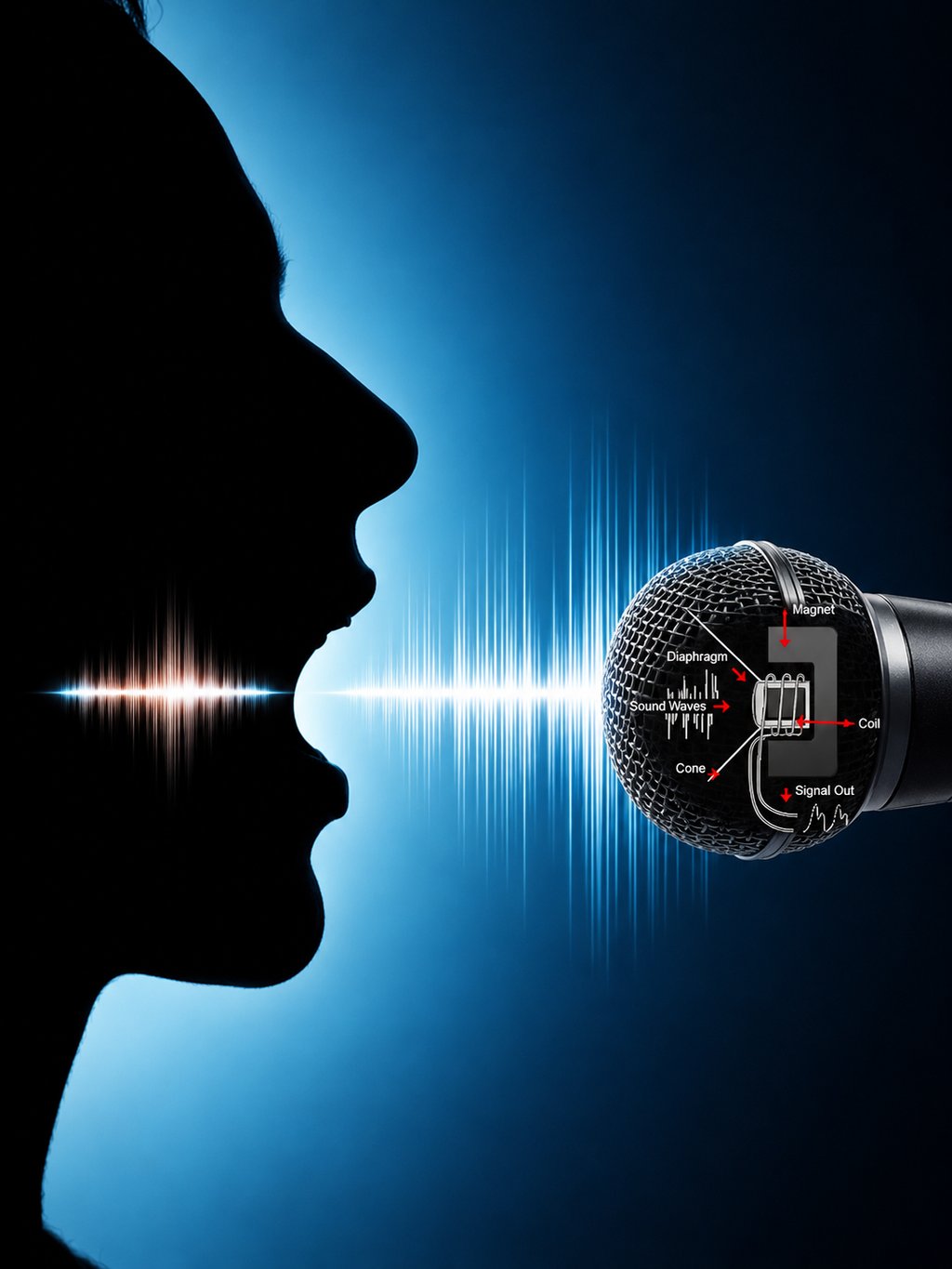
Modern recording equipment does not distinguish between ordinary and unusual sounds. A microphone simply converts changes in air pressure into an electrical signal. If a faint whisper, distant voice, or other sound reaches the microphone's diaphragm, it will be recorded regardless of whether investigators consciously noticed it at the time.
Because of this, every suspected EVP should first be examined for conventional explanations, including:
Distant conversations
Environmental sounds
Radio frequency interference
Audio compression artefacts
Mechanical noise
Wind movement
Wildlife
Auditory pareidolia (the brain interpreting random sounds as speech)
Only after these possibilities have been carefully considered should the recording be regarded as an unexplained audio anomaly.
Why Are EVPs Controversial?
The scientific community has not reached a consensus that EVPs represent communication from spirits or deceased individuals. Many researchers argue that most recordings can be explained by environmental factors or the human tendency to recognise familiar speech patterns in ambiguous sounds.
Paranormal investigators, however, continue to study EVPs because some recordings appear unusually clear, contextually relevant, or seemingly responsive to questions asked during an investigation.
Whether these recordings represent environmental anomalies, unknown physical phenomena, or something beyond current scientific understanding remains an open question.
A Scientific Definition
An Electronic Voice Phenomenon (EVP) is an unexplained voice-like audio anomaly recorded by electronic equipment that was not consciously perceived during the original recording and whose source cannot be immediately identified.
Why Did ProParanormal Use a Dynamic Microphone?
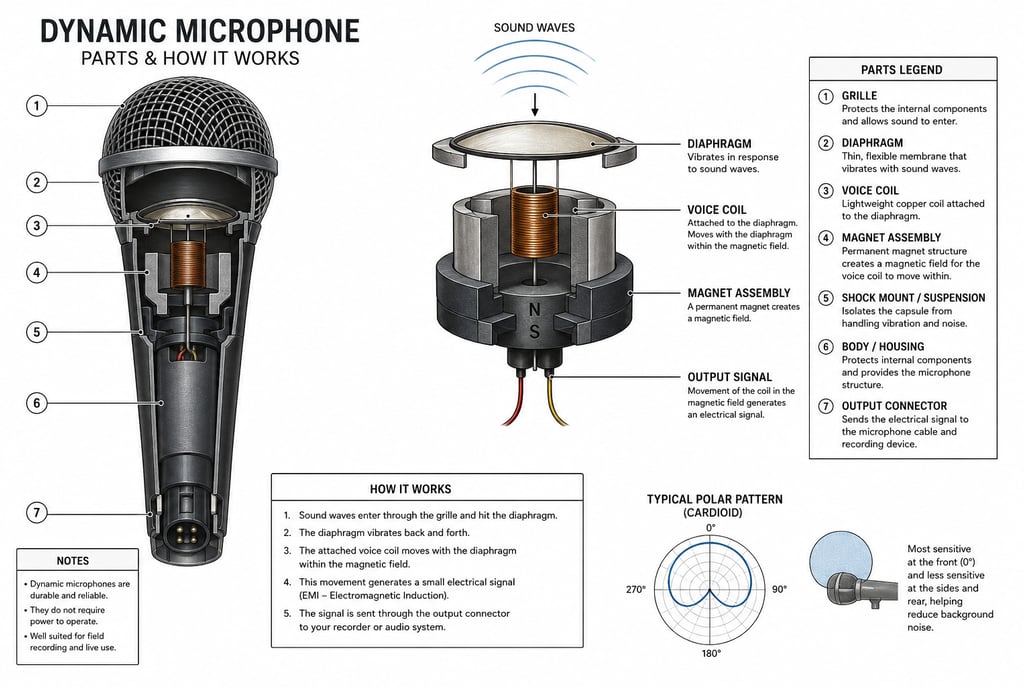
Dynamic microphones are widely used because they are durable and reliable in field investigations. They work by converting sound waves into electrical signals through the movement of a diaphragm attached to a small coil suspended within a magnetic field.
Unlike the human ear, which naturally filters out background sounds and focuses attention, a microphone records everything within its pickup pattern. During later playback, investigators may notice faint sounds that went unnoticed while concentrating on the investigation itself.
This does not automatically make every unexplained sound paranormal. Responsible investigators should always consider environmental noises, distant voices, radio interference, and other natural explanations before reaching conclusions.
DYNAMIC MICROPHONE
Incoming Sound Waves (Voice / EVP / Ambient Sound)
↓↓↓↓↓
┌───────────────────────────────────────┐
│ Protective Metal Grille │
└───────────────────────────────────────┘
▼
Flexible Diaphragm
(Moves with sound pressure)
▼
Small Copper Voice Coil
(Attached to the diaphragm)
▼
Moves backwards and forwards
▼
Permanent Magnet Assembly
(Creates a strong magnetic field)
▼
Motion of the coil through the magnetic field
generates a tiny electrical current
▼
Microphone Output Signal
▼
Audio Recorder / Camera
▼
Digital Audio File (WAV/MP3)
▼
Headphones & Audio Analysis Software
▼
Possible identification of an EVP during evidence review after recording
How it Works
1. Sound Waves
Every sound in the room, including speech, footsteps, distant noises, and any unexplained sounds, travels through the air as pressure waves.
↓
2. Diaphragm
These waves strike a very thin diaphragm inside the microphone.
The diaphragm vibrates exactly in time with the incoming sound.
↓
3. Voice Coil
Attached to the diaphragm is an extremely lightweight copper coil.
As the diaphragm vibrates, the coil moves with it.
↓
4. Magnet
The coil sits inside the magnetic field of a permanent magnet.
Whenever the coil moves through this field, Faraday's Law of Electromagnetic Induction causes a tiny electrical voltage to be generated.
↓
5. Electrical Signal
This voltage is an exact analogue of the sound wave.
Louder sounds create larger voltages.
Quieter sounds create smaller voltages.
↓
6. Recorder
The recorder amplifies and digitises this signal, preserving everything the microphone detected within its frequency response and pickup pattern.
↓
7. Evidence Review
During playback with headphones, investigators sometimes notice sounds that were not consciously heard during the investigation itself.
These may include:
whispers
distant voices
knocks
footsteps
unexplained noises
Some investigators classify certain unexplained recordings as Electronic Voice Phenomena (EVPs) after careful analysis.
VOICE
FOOTSTEPS
AMBIENT NOISE
POSSIBLE EVP
▼
Dynamic Microphone
▼
Electrical Signal
▼
Digital Recorder
▼
Audio Review
▼
Possible EVP Identified
One Scientific Point Worth Mentioning
A dynamic microphone does not "hear ghosts." It converts all acoustic energy within its operating frequency range into an electrical signal. During later review, investigators may identify faint sounds or voices that were not consciously perceived at the time because attention was focused elsewhere or because the sounds were too subtle to notice in real time.
That distinction is important because it reflects an evidence-based approach: the microphone records sound, and the interpretation of unusual recordings comes only after careful analysis and consideration of conventional explanations.
Which setting is preferred: 0 dB or +10 dB
The difference between 0 dB and +10 dB on a microphone or recorder is microphone gain, how much the incoming electrical signal is amplified before it's recorded.
At 0 dB
No additional amplification is applied.
The microphone records at its normal output level.
Background noise remains relatively low.
Loud sounds are less likely to distort (clip).
Best for:
close conversations
loud environments
people speaking directly into the microphone
Whisper █
Speech █████
Shout █████████
At +10 dB
The recorder increases the microphone signal by 10 decibels.
This means:
quieter sounds become much easier to hear
distant voices become more noticeable
faint ambient noises are amplified
electronic hiss (noise floor) is also amplified
Whisper ████
Speech █████████
Shout ██████████████
Everything becomes louder, including unwanted sounds.
How Much Louder is +10 dB?
A 10 dB increase corresponds to:
10× the electrical signal (power)
approximately 3.16× the voltage (signal amplitude)
perceived by most people as about twice as loud
So +10 dB doesn't just make the desired sound louder, it raises everything entering the microphone.
In Paranormal Investigations
Suppose you're standing in a quiet museum asking:
"Can you tell me your name?"
At 0 dB
The recorder might clearly capture:
your voice
footsteps
nearby ambient sounds
A very faint whisper could remain buried near the recorder's noise floor.
At +10 dB
Now the recorder becomes more sensitive to:
distant whispers
soft breathing
clothing movement
air-conditioning
insects
echoes
handling noise
If a genuine faint acoustic sound is present, it has a better chance of standing out, but so does every other source of noise.
Dynamic Microphones
One important point is that +10 dB does not make the microphone itself more sensitive.
A dynamic microphone always produces the same electrical signal for the same sound pressure.
The recorder's microphone preamplifier boosts that signal before it is digitised.
The signal path looks like this:
Sound
▼
Dynamic Microphone
Small Electrical Signal
▼
Microphone Preamp
0 dB or +10 dB
▼
Recorder
▼
Digital Audio File
Which Setting is Better for EVP?
There isn't a single "best" setting.
0 dB produces cleaner recordings with less hiss and is suitable when people are close to the microphone.
+10 dB can help capture very quiet sounds in a silent environment, but it also amplifies ambient noise and the recorder's own electronic noise.
Many experienced investigators prefer to record with enough gain to capture faint sounds without clipping loud speech. They then perform careful analysis later rather than relying solely on high gain during recording.
For a controlled investigation like the museum or Bohlandor sessions, +10 dB can be useful in very quiet conditions, provided you're aware that it increases both the desired signal and the background noise.
ProParanormal's 18 Hertz Threshold Theory
Important: This is an investigative hypothesis explored by ProParanormal and should not be interpreted as an established scientific mechanism for EVP production.
However, this is an interesting theory, and the answer requires an important distinction between sound and electromagnetic phenomena.
An Electronic Voice Phenomenon (EVP) is generally defined as an unexplained voice or sound that is captured on an audio recording but was not consciously heard by investigators at the time. The mechanism behind EVPs has never been scientifically established.
Regarding 18 hertz (Hz):
20 Hz to 20,000 Hz is generally considered the normal range of human hearing.
Below 20 Hz is called infrasound.
A dynamic microphone can respond to frequencies below 20 Hz, depending on its design and frequency response, although many microphones and recorders intentionally roll off very low frequencies to reduce handling noise, wind rumble, and vibration.
So, if an acoustic pressure wave existed at 18 Hz, a microphone might record it, even if most people could not hear it directly. However, there are several important considerations.
An 18 Hz tone is not a voice. Human speech contains a wide range of frequencies, with most intelligible speech energy occurring roughly between 100 Hz and 8,000 Hz. While a very deep voice may have a fundamental frequency around 80–100 Hz, the consonants and harmonics that make words understandable occur at much higher frequencies.
This means that a complete spoken phrase cannot exist solely at 18 Hz. If you recorded only an 18 Hz sound, it would resemble a low rumble or vibration rather than recognizable speech.
Where things become more interesting is if an EVP contains energy extending into the infrasonic range while also containing higher-frequency components that make the words intelligible. In that case, the recording could show unusually strong low-frequency energy accompanying the voice, but the speech itself would still rely on higher frequencies to be understandable.
For our Bohlandor investigation, if the audio analysis showed that the rasping voice captured on 26th June 2021 had significant energy below 18 Hz, it would be more accurate to describe it like this:
Spectral analysis indicated that the recorded voice exhibited unusually strong low-frequency energy extending below 18 Hz, alongside higher-frequency components that made the spoken words intelligible. While the recording contained infrasonic content, the audible speech itself was not composed solely of frequencies below 18 Hz.
This wording is scientifically cautious. It reports what was observed in the recording without claiming that EVPs are caused by infrasound or that voices can exist entirely below the range of human hearing. Such a claim has not been demonstrated by established scientific evidence.
Interpreting ProParanormal’s EVP Capture At The Museum
Whether the whispered response genuinely represents an Electronic Voice Phenomenon is ultimately for each listener to decide. My role as an investigator is not to tell people what to believe, but to document unusual events honestly, preserve the original recordings, and present them for others to evaluate.
What I considered present on the MP4 file audio find was the following:
Distant conversations
Environmental sounds
Audio compression artefacts
Wind movement
Auditory pareidolia (the brain interpreting random sounds as speech)
Could the EVP Simply Be Contamination?
One of the first questions I asked myself when reviewing the recording was "Could the EVP have been contamination?" The whispered "no" could have originated from the other investigator.
At the time the recording was made, a colleague could be heard in the background speaking with another person regarding PlayStation gaming and consoles. During their conversation, he repeated the words "no, no, no" consecutively as a rushed response to a question.
On the surface, this appears to offer a straightforward explanation. However, closer examination of the recording revealed several notable differences.
My colleague's voice was clearly positioned some distance from the recording equipment, two rooms apart in fact. His speech carried the natural characteristics of someone speaking across the room, with reduced volume, room reverberation, and ambient acoustics consistent with his location.
The whispered response, by contrast, possessed a very different acoustic quality. It appeared extremely close to the dynamic microphone, lacking the reverberation and distance cues present in the background conversation. Instead of sounding like a voice travelling across the room, it had the intimate quality of a whisper spoken only inches from the microphone.
Equally significant was its timing. The whispered "no" occurred immediately after the direct question:
"Can you tell me your name?"
And at the exact same moment my colleague said:
“No, No, No”.
While this does not establish a paranormal origin, it makes the recording particularly interesting from an investigative perspective.
As with every piece of evidence documented by ProParanormal, the recording should be examined critically. A voice-like sound on an audio recording is not, by itself, proof of paranormal activity. Environmental acoustics, overlapping speech, microphone characteristics, and other conventional explanations must always be considered before drawing conclusions.
Ultimately, I present the recording as an unexplained audio anomaly. Whether listeners interpret it as coincidence, an acoustic artefact, or a genuine Electronic Voice Phenomenon is a matter of individual judgement.
This philosophy forms the foundation of every investigation conducted by ProParanormal.
No reactions. No gaslighting. No jump scares. No staging.
Just careful documentation, methodical investigation, and evidence presented as faithfully as possible.
None of these tests proves that the recording is paranormal. The objective is to determine whether a conventional explanation adequately accounts for what was recorded at the Rock and Gem Museum.
The EVP Capture: What Happened at the Museum
During an investigation inside a North American rock and gem museum, I positioned a dynamic microphone to record the surrounding environment.
I asked:
"Can you tell me your name?"
No response was consciously heard.
During later evidence review, however, a faint whispered sound appeared immediately after the question. It appeared to say:
"No."
Date: 26 June 2021
Location: North American rock and gem museum
Recording method: Dynamic microphone
Gain: +10 dB
Response heard live: None
Possible recorded response: "No"
Classification: Unexplained audio anomaly / possible EVP
Known contamination: Background conversation two rooms away
ProParanormal conclusion: Inconclusive
Listen to the Original Recording with headphones before reading our interpretation below. What, if anything, do you hear immediately after the question?
"Can you tell me your name?"
Don't read further until you've listened.
This helps reduce suggestion bias before we tell you what we believe the recording may contain.
As with all EVP recordings, I encourage you to listen critically and draw your own conclusion.
ProParanormal:
Pro-efficient
Pro-active
Pro-fessional
Contact
© ProParanormal 2026 All rights reserved.
info@proparanormal.com




Use code PROPARANORMAL to save an additional 50%
🔒 All submissions are encrypted via HTTPS and treated as confidential.